
DAFF admits to breaching privacy in ongoing slaughterhouse cruelty case
 View as a PDF
- The Department of Agriculture, Fisheries and Forestry (DAFF) has admitted to breaching the Privacy Act in their handling of an animal cruelty complaint in February 2024.
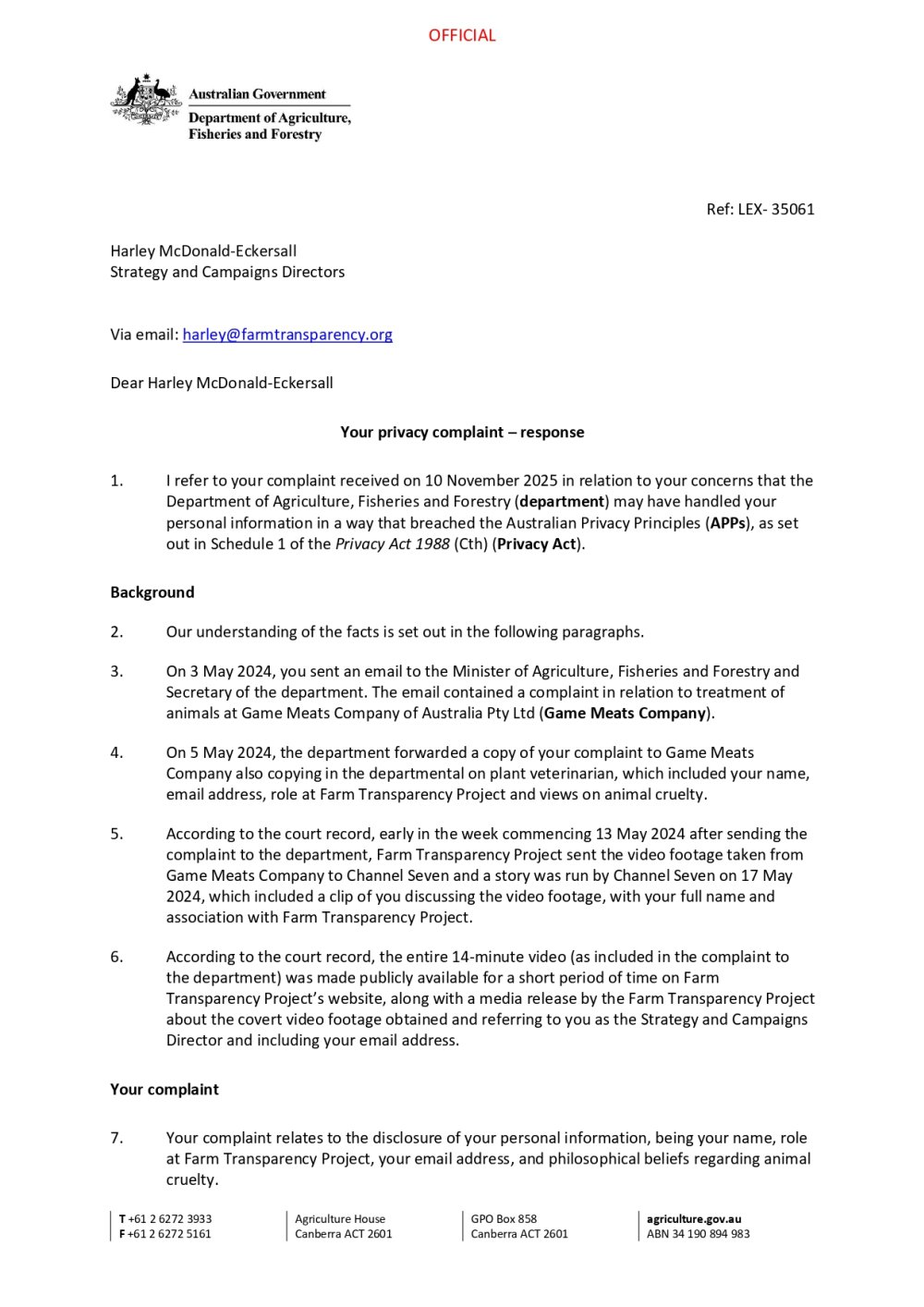
- The Department was found to have disclosed personal information of a witness to animal cruelty, to the subject of an animal cruelty complaint, after a director of Farm Transparency Project made a formal complaint about practices at the Game Meats Company slaughterhouse.
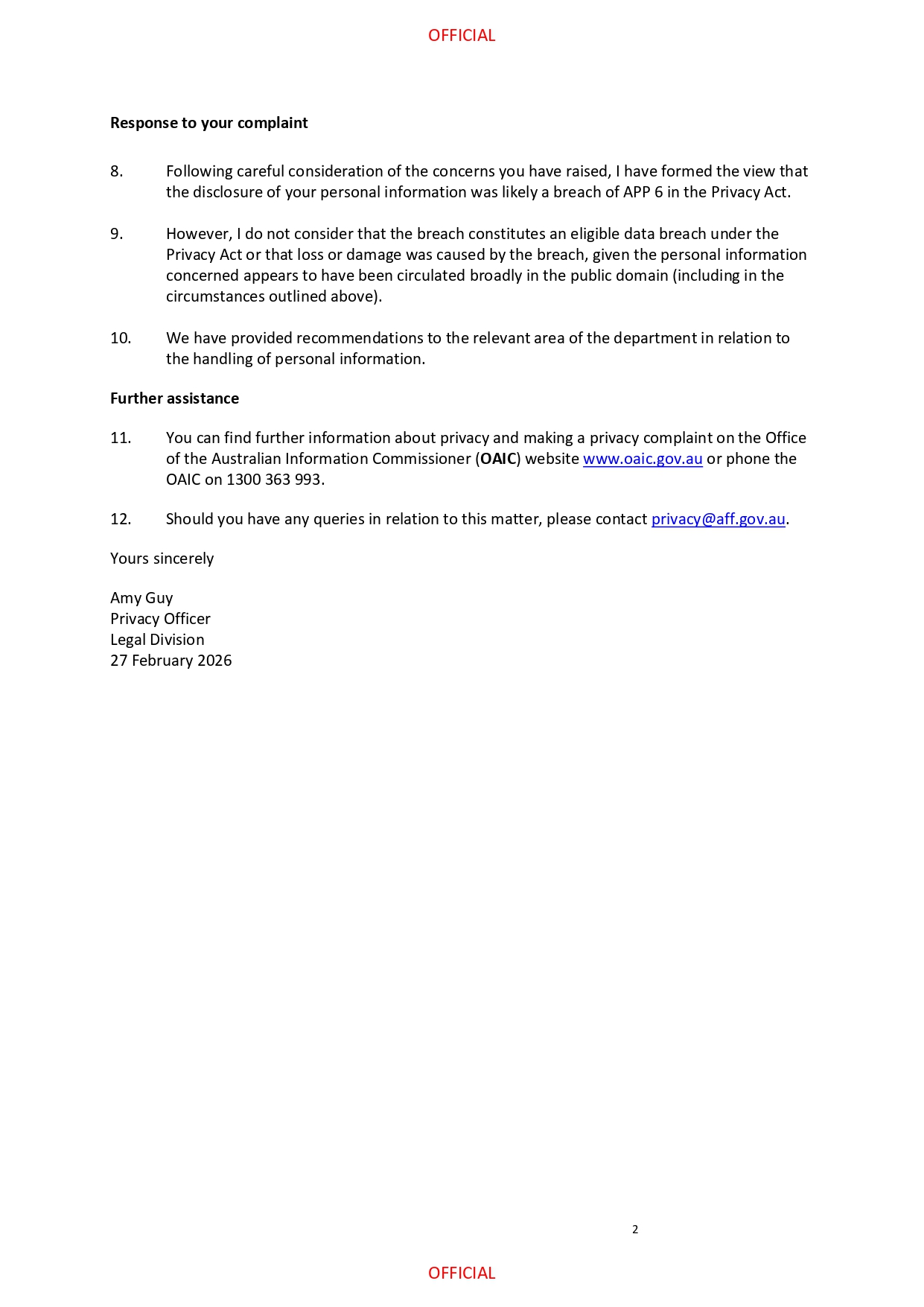
- After a complaint and investigation by the Department's privacy officer, DAFF admitted to breaching the Privacy Act in their handling of sensitive, protected information, however decided that no further action was required from the Department.
The Australian government's Department of Agriculture, Fisheries and Forestry has been found to have breached the Privacy Act, after they shared a formal complaint regarding animal cruelty to the subject of the complaint, complete with the complainant's details including her full name, email and phone number.
Harley McDonald-Eckersall requested that DAFF conduct an internal privacy review, after her personal information was leaked to the Game Meats Company, where she claimed she witnessed acts of animal cruelty, through covert cameras installed by Ms McDonald-Eckersall and Farm Transparency Project, where she is a director.
According to DAFF's privacy policy, personal information refers to "any information or opinion about an identified individual, or an individual that is reasonably identifiable." They also define sensitive information as "a subset of personal information and generally has a higher level of privacy protection than other personal information." Included within sensitive information is "philosophical beliefs" and "trade or professional associations and memberships."
DAFF's privacy policy sets out that they "will only use and disclose your personal information for the purposes for which it was collected, or otherwise in accordance with the Privacy Act." They also specify that "personal information may be collected, used and disclosed (including to/from third parties) to enable the department to achieve its function and perform its activities."
In her complaint, McDonald-Eckersall argued that DAFF mishandled both personal information (email address and full name) and sensitive information, specifically her philosophical beliefs that can be inferred from the act of making a formal complaint about animal cruelty.
"Making a complaint about something as concerning as animal cruelty is something that is difficult for any person to do, particularly when there is the risk of personal retribution from those engaged in the cruelty. It was my understanding when contacting DAFF with an urgent formal complaint, that my personal and sensitive information would be treated as confidential and only disclosed if it was necessary for them to complete their duty to investigate animal cruelty at Australian export slaughterhouses. Instead, DAFF carelessly passed on my information to the very people who I was reporting, exposing me to potential repercussions."
McDonald-Eckersall stated in her complaint that "this breach of privacy has had a significant effect on my mental health and wellbeing. I have experienced stress and anxiety knowing that the subjects of my animal cruelty complaint knew that I was the one who had reported them to DAFF. It also concerns me that I have no information regarding how these parties will use my information and how long they may keep it. This is despite DAFF's privacy policy stating that 'if the department discloses your personal information to a third party, it will take reasonable steps to ensure that the third party handles your personal information in the same manner as the department and in accordance with the APPs.'"
"The breach directly resulted in litigation against Farm Transparency Project, and during the subsequent hearings in the Federal Court I was forced to take the stand and was subjected to harassment, ridicule and insults in an attempt to undermine the seriousness of the complaint I had lodged and misconstrue my motivations in doing so. The evidence of animal cruelty, which itself had been extremely distressing for me to review, became the subject of an injunction, preventing it from ever seeing the light of day and affording the slaughterhouse an absolute lack of consequences for its cruel and illegal conduct; this lack of action has further compounded my stress and anxiety and has been deeply upsetting. Undoubtedly, this would not have occurred if not for DAFF's careless actions."
After an investigation by the Department's Privacy Officer, Amy Guy, the Department concluded that "the disclosure of (McDonald-Eckersall's) personal information was likely a breach of APP 6 in the Privacy Act... However, I do not consider that the breach constitutes an eligible data breach under the Privacy Act or that loss or damage was caused by the breach, given the personal information concerned appears to have been circulated broadly in the public domain."
The circulation in the public domain refers to a media appearance by Ms McDonald-Eckersall on 7 Border News, where she discussed the video footage, and the publication of the footage itself, for a short time on the Farm Transparency Project website. However, as McDonald-Eckersall argues, "At no point was it disclosed that I was the one who had made the animal cruelty complaint against the Game Meats Company. Responding to allegations of cruelty, once they are made public, is a very different thing to making those allegations in the first place and DAFF is ignoring the real risks their carelessness poses to whistleblowers who seek to report instances of cruelty in their community."
McDonald-Eckersall has said that she is seeking a public apology from DAFF, and financial compensation commensurate to the breach of her privacy and the emotional distress it has caused. She says that she plans to lodge a complaint with the Office of the Australian Information Commissioner, the national regulator for privacy and freedom of information.
< Return to latest media releases
Sign up to receive media releases by email