
Kangaroos
Kangaroos – Introduction
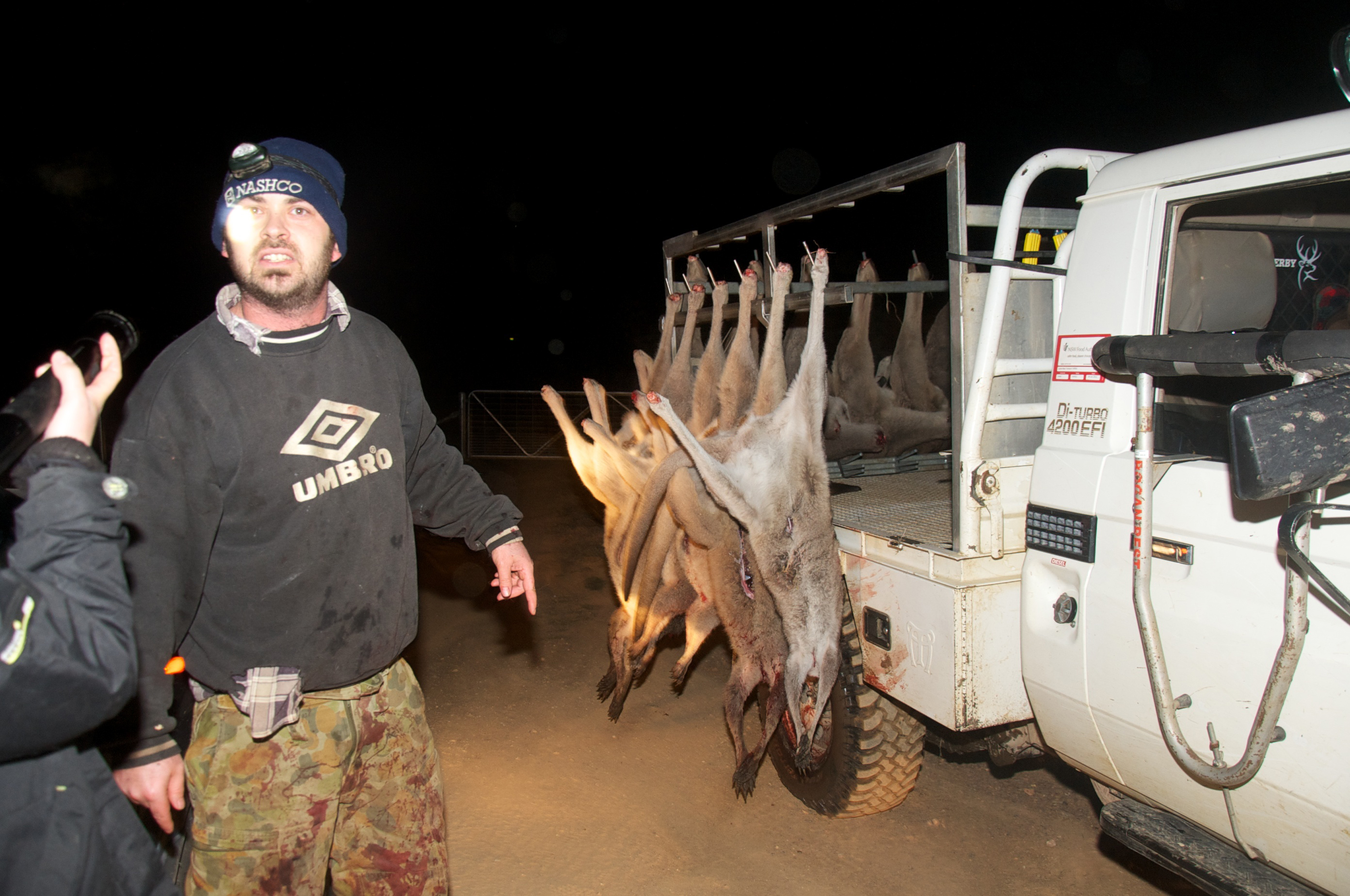
Kangaroos are hunted each year in Australia either for commercial gain (for their skin and flesh) or simply to be 'culled' to 'control their numbers'. Permits are issued to 'legally' kill Kangaroos – so the Government and the shooters all slaughter them in their millions.
The Australian Government requires kangaroo management plans (approved under the Environment Protection and Biodiversity Conservation Act of 1999) be developed before kangaroo products may be commercially exported, however this does nothing to protect the animal.
With ongoing deforestation, the natural habitat of Kangaroos is getting smaller and sighting them on the fringes of suburbia is becoming more common.
.jpg)
Roos in the wild
Part of their own matriarchal society, Kangaroos hop together in what's called a 'mob', up to 60 kilometres per day if needed (e.g. if they're moving away from danger). A joey will either stay with mum for around three years before moving on (males) or stay with mum forever (females).
Typically, just one dominant male will breed with the females in the mob. This roo will defend his breeding rights by fighting other males if need be. Other males in the mob sometimes fight with one another to establish their own position in the hierarchy.
The family unit will eat together, sleep together and move on as one. Mother's (and sisters of the mother) protect their young at all costs. Family members have been observed hugging one another in the wild (sisters in particular). Kangaroos display very individual characteristics and value both their own family and their own lives.
A bullet to the head (or often the neck) or worse for the babies
Adult Kangaroos are supposed to be shot in the head while for the babies, smashing in their head or decapitating them are the methods recommended in the 'Code of Practice for the Humane Shooting of Kangaroos'.
It's clear (from previous studies performed by both the RSPCA and Animal Liberation) that not all Kangaroos die quickly. Neck shots are common, creating further suffering for the animal before being killed. The figures between the two studies of neck shots varied (RSPCA's was just over 4% and Animal Liberation's concluded up to 40%) but whatever the final number may be, many suffer a lingering, painful death. It's a cruel, unnecessary outcome for those shot in the head as well.
Baby Joeys
The code states that for the female roos shot or injured the animal must be 'thoroughly examined for pouch young' but the reality is all-too-often this: the mother is often shot and left to rot – the baby crying out with a small cough that is never returned. The baby with either die of exposure, starvation or be found and eaten by a predator.
Mothers' have been observed in great distress when separated from their young. If separated, a baby joey will cry out for mum in anguish. This family is destroyed when the mother is killed and the defenceless baby left either to die slowly or, even if the code is followed, in a very cruel way at the hands of a shooter.
Each State charged with both endorsing their slaughter and protecting them
It's up to each state to enforce the code and support the commercial Kangaroo industry. Being the same body that's supposed to protect the animal creates a significant conflict of interest. This is a classic case of putting the fox in charge of the hen-house and animal cruelty and abuse has zero chance of being tackled under this model. A study in 2012 concluded that 'Government agencies in Australia do not carry out regular and adequate inspections of all levels of activity in the kangaroo industry'. Not that any form of 'protection' that involves killing the animal is acceptable.
These agencies are: Macropod Management Unit of the Department of Environment and Resource Management (QLD), Kangaroo Management Program of the Office of Environment and Heritage (NSW), the Department of Environment and Conservation (WA), and the Department for Environment, Water and Natural Resources (SA).
Kinder alternatives to control Kangaroo numbers
If it was a requirement to control Kangaroo numbers, there are much kinder ways to do so than a 'cull'. Reproduction suppressant programs do work, and while not yielding immediate results, they are proven to create a decline over time. While we don't endorse capture (and translocation if required) and fertility control (where the male is castrated), it is an alternative to a bullet to the head.
Statistics
In 2023, a total of 1,361,679 macropods were killed in five states of Australia for commercial use. While kangaroos were the most frequently killed, wallabies and wallaroos were also included in this figure.
This consisted of:
Victoria: 72,232
Western Australia: 81,938
South Australia: 100,088
New South Wales: 509,671
Queensland: 597,750
Wallabies are also killed commercially in Tasmania for their meat, skin, and fur. In 2025, Tasmanian abattoir Lenah Game Meats applied to extend their annual license to export the flesh and fur and skin of 200,000 wallabies
Kangaroo meat is both sold in Australia and exported overseas to approximately 60 countries.