In December 2025, we released damning allegations from two ex-workers at Josh's Rainbow Eggs (JRE) claiming that, during their employment on the farm, they experienced demeaning conditions - including being forced to clean floors with toothbrushes - and witnessed severe animal cruelty. At the same time, we published footage received from anonymous investigators, who had documented filthy conditions, and sick and dead hens, inside Josh's sheds. Footage and photos provided to Farm Transparency Project also showed that over 100 birds had died in a single shed in just a few weeks.
Following our publication of these statements and footage, Josh's made changes to their website, removing all uses of the word ethical, which had previously been used in the main tagline of their brand. But that wasn't all that they changed.
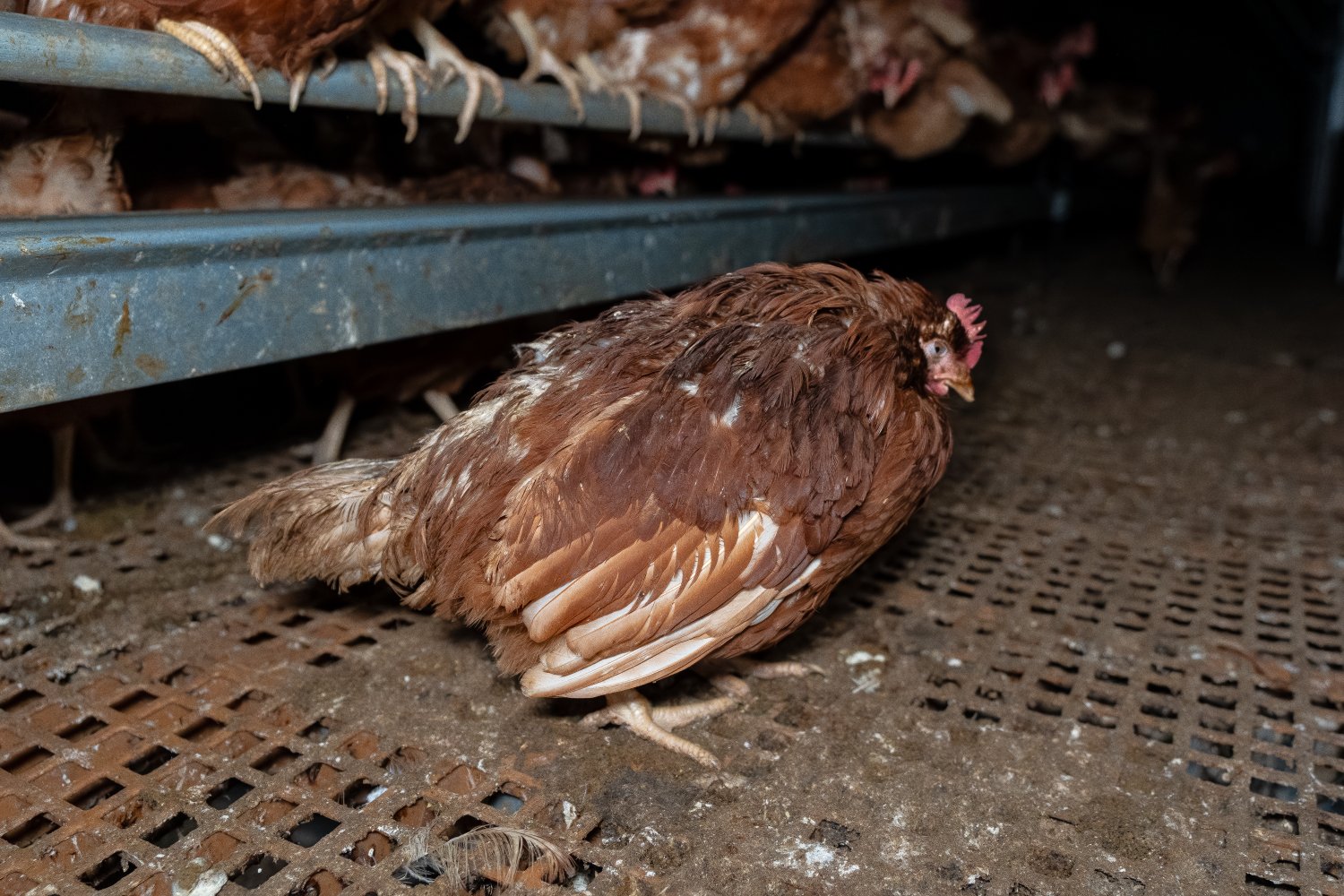
A hen at Josh's Rainbow Eggs. Photo: Farm Transparency Project (2025)
Backyard Hens
Since their early days, one of JRE's selling points was that they rehome all their ex-layer hens to 'backyard families,' where they are allowed to 'live out their lives.' This claim was designed to set them apart from traditional egg factory farms, where chickens are killed on farm or sent to slaughter at just 18 months old, which is when their productivity begins to decline.
As soon as we started to research Josh's Rainbow Eggs, we had doubts about this claim. In a report by 9 News in 2025, Josh claims that there are roughly 50,000 hens on one farm. To rehome such a large number of hens would be a massive operation, yet we found no evidence of a large-scale rehoming project in the Monegeetta area.
The Lie
After publishing our investigation into Josh's, we contacted them, sending a formal complaint regarding what we saw as false and misleading claims made by their business. In this letter, we raised our doubts about their claim to rehome their ex-layer hens, and challenged them to provide evidence. Instead, they attempted to cover their tracks.
Almost immediately, their website was changed, removing the reference to rehoming hens and adding a statement that, since May 2024, they had been sending all their hens to slaughter once their productivity begins to decline.
After bird flu impacted 11 farms in Victoria in May 2024, we have been unable to give away our older hens to backyarders. This is not allowed as it poses a significant risk to the entire egg industry. We have found a local processor who is processing all our hens for human consumption. Our goal is to work with a charity partner so we can have this valuable protein shared with families in need.
So there it was. A lie that had been maintained by the company for over 1.5 years, during which time their website had proudly claimed that their hens were living out their lives, while in reality they were being sent to slaughter. Even as the website copy was amended, as of March 2026 a video on their about page still states that all hens are rehomed to live out their lives as 'laying chickens in a backyard.' But, let's be honest, anyone who has run a business knows that outdated copy is something that can happen on websites. So, were we being too harsh to call them liars based only on one paragraph of text on their about page and an outdated video?
They could potentially be forgiven for overlooking this lie, if not for an interview Josh did in April 2025 on the Inspired CEO podcast, which was published on the podcast's Instagram, and on Spotify and Apple Podcasts. In the interview, the host, Kate Save, asks Josh about their rehoming project. Josh responds, confirming that they have been doing the rehoming 'for a while now', but that it is getting harder and harder to find homes for ex-laying hens. Avoiding the word slaughter, Josh says that they've managed to 'not do that [get rid of the hens], anywhere near as much as [their] competitors.' He then goes on to lament the reasons that 'spent' hens are sent to slaughter, describing it as tragic and detailing the commercial risks involved in keeping hens beyond their second moult.
Farm Transparency Project has since confirmed that Josh's Rainbow Eggs has been sending hens to Star Poultry, a chicken slaughterhouse in Keysborough, for at least two years. However, the slaughterhouse was only able to confirm that they have killed between 5000-10,000 spent hens from Josh's farm. Leading to the question, what is happening to the remaining tens of thousands of hens?
This interview, published over a year after JRE's adjusted statement says they had been forced to stop rehoming hens, is proof that the claims on their website were not an accident or oversight, but a deliberate omission and deception, designed to make the company seem far more ethical than they are. Even when they finally did admit to sending hens to slaughter, they cited external pressure, implying that they would have continued to rehome hens to 'backyarders', but that this was no longer allowed. In a phone conversation with a member of the public, relayed to FTP investigators, JRE CEO Tamsyn Murray stated that it was the Department of Agriculture who had told JRE that they could no longer rehome their hens, due to the risk of spreading bird flu throughout Victoria. Given their track record of honesty so far however, we didn't take them at their word.
Is Rehoming Banned?
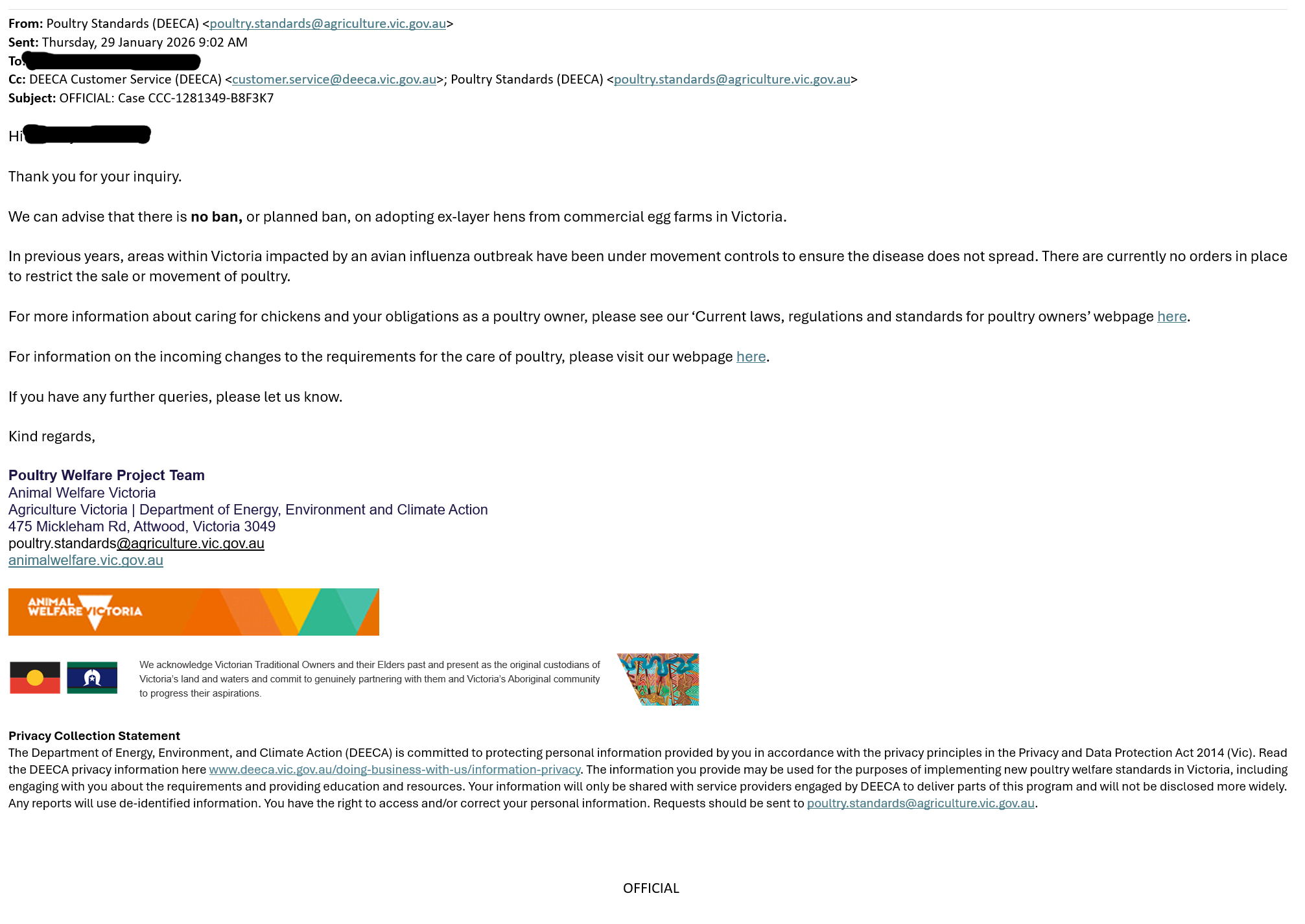
In late 2025, a volunteer acting on behalf of Farm Transparency Project contacted the Department of Agriculture and asked them whether they had ever placed a ban on the selling or rehoming of ex-layer hens in Victoria. Their response was an unequivocal no.
Farm Transparency Project also contacted an animal rescue group who regularly organised mass rehomings of hens from commercial egg farms in Victoria and interstate. They informed FTP that they had never had any restrictions placed on their activities, apart from avoiding quarantined areas during the bird flu outbreak. They had been in contact with the Department of Agriculture on previous occasions and had followed all advice given to them.
Yet again, Josh's Rainbow Eggs had been caught in a lie.
Rehoming gone wrong
After we published evidence of Josh's deceptions, we put a call-out to anyone who had participated in their rehoming program, determined to discover if any hens had actually been rehomed from the farm. Within days, we were contacted by a former 'heritage egg' farmer, who, five years previously had bought 200 hens from Josh's Rainbow Eggs. Fearing retaliation from the farm, they requested to remain anonymous. We'll call her Sarah.
At the time that these events occured, Sarah was the owner and operator of a small, organic, egg business. She kept 200-250 hens, along with some roosters, who were fed on organic food and were rehomed at 4-5 years of age. As demand grew, she sought to increase production and decided to give ex-layer hens a second chance at life, rather than purchashing new chicks. She was drawn to Josh's Rainbow Eggs due to their claims of being an 'ethical' business who rehomed all their 'spent' hens, rather than sending them to slaughter.
After speaking with Josh's CEO, Tamsyn Murray, Sarah agreed to purchase 200 spent hens at $1 per bird.
When she arrived at the farm, these were her first impressions:
"I was surprised by what I saw as it was different from the advertising and public image of the business.
There were several chicken tractor barns that had small poultry mesh pens around them. A Maremma was on guard. The buildings looked semi-permanent – meaning they were not moved – and the birds were let out via flaps in the barn. The ground around the barns was in good condition (not grazed) and there wasn't obvious evidence of the barns being moved to provide new fodder or regenerate the soil in other places.
As it was getting dark, the birds were going in for the night. The barn was appropriately cleaned but contained a large number of birds – the 200 I took didn't put even the smallest dent in the population. There were many, many feeders and nest boxes. It appeared that the birds lived in the barn and were let out for a short time. I did witness 2 dead birds while I was working with the workers and Tamsyn to catch my 200 birds and load them in my trailer."
But the problems didn't really begin until Sarah arrived home with the 200 new hens. Initially, the hens didn't understand how to use the chicken tractor which was used on Sarah's farm. A chicken tractor is a mobile coop which can be regularly moved to different areas. The birds taken from Josh's didn't understand how to go in at night, taking over a week to be taught something that takes most hens just three nights to learn. Sarah felt that "it was like they lived in a barn most of the time."
Within days, the condition of the birds quickly deteriorated and worrying behavioural issues became apparent:
"Within a few days of getting the birds to my farm and on to the organic feed, they began to die off. In a few weeks we lost over half of the chickens we purchased from Josh's. I was so concerned that I took them to the vet who recommended I take them to Monash for testing to see if there was some sort of communicable disease. The outcome was negative for any communicable diseases. The only thing the vet could offer was that it was a reaction to new feed.
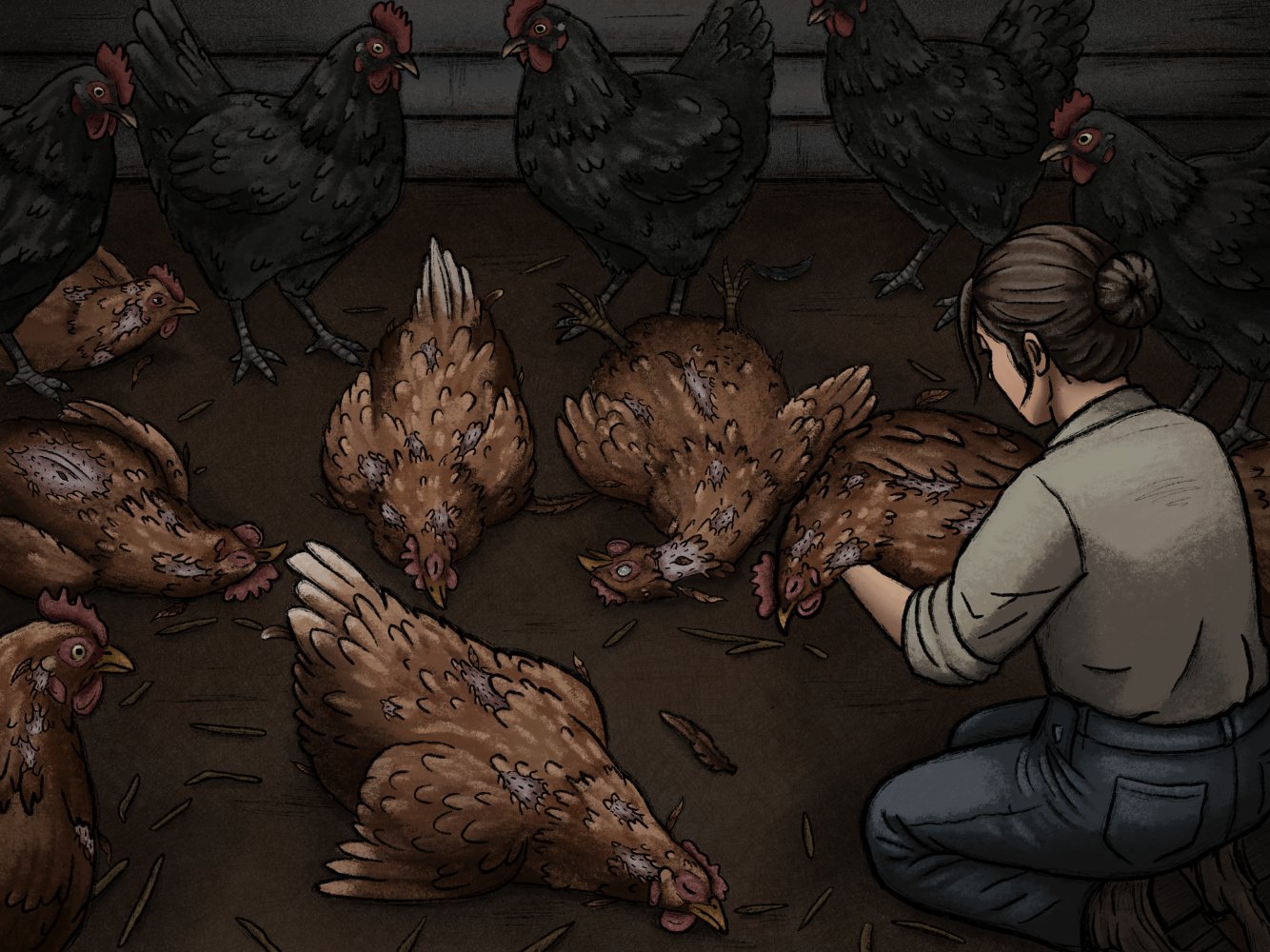
I performed a necropsy on several of the birds early on and noticed that they had enlarged organs, fatty liver and internal tumours. They were not healthy on the inside."
Illustration of Sarah holding a dead hen from Josh's. Artist: Jess_hartartist
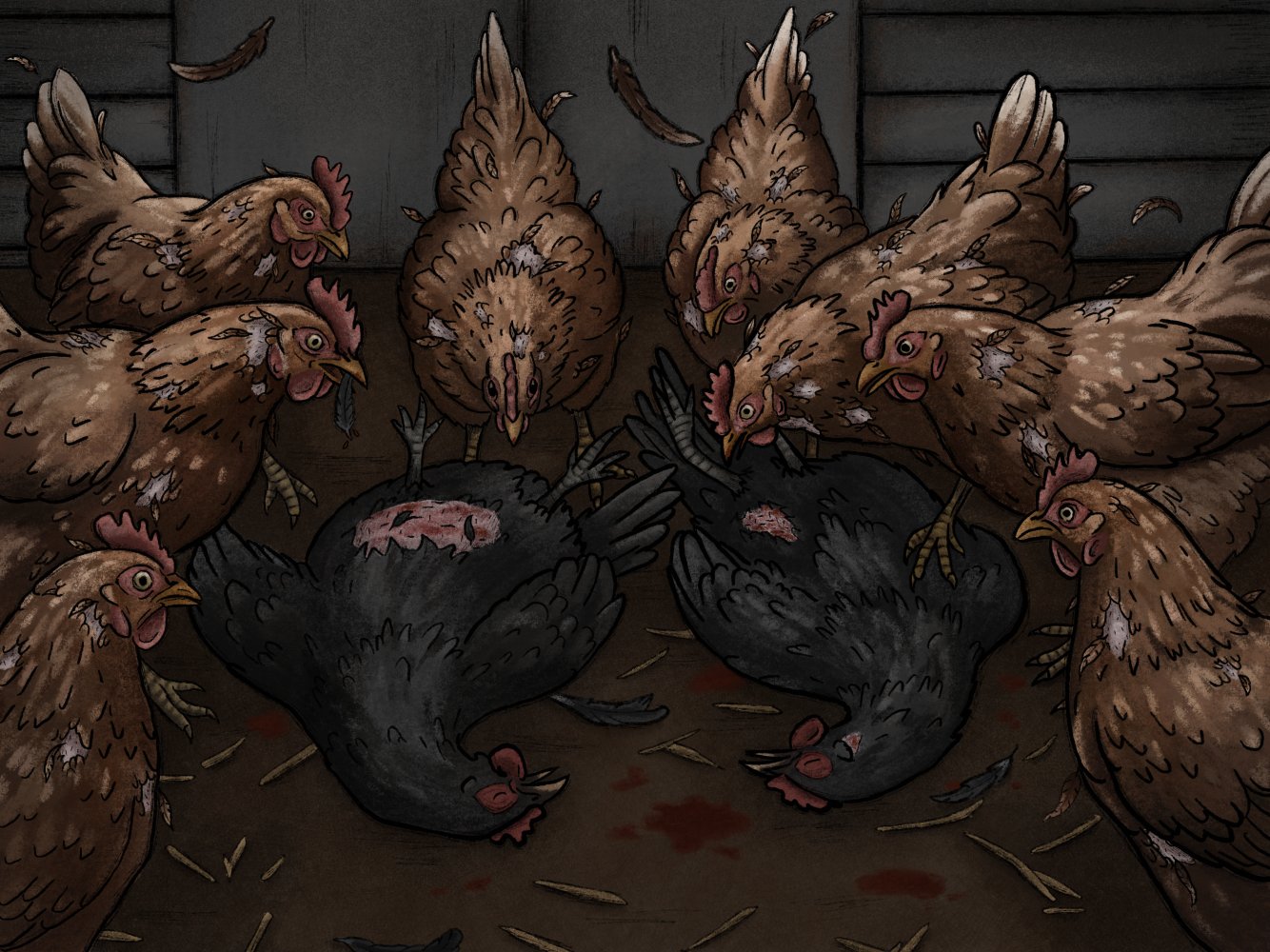
The birds that survived the initial die-off became aggressive and manic, brutally pecking to death several of Sarah's docile, heritage hens.
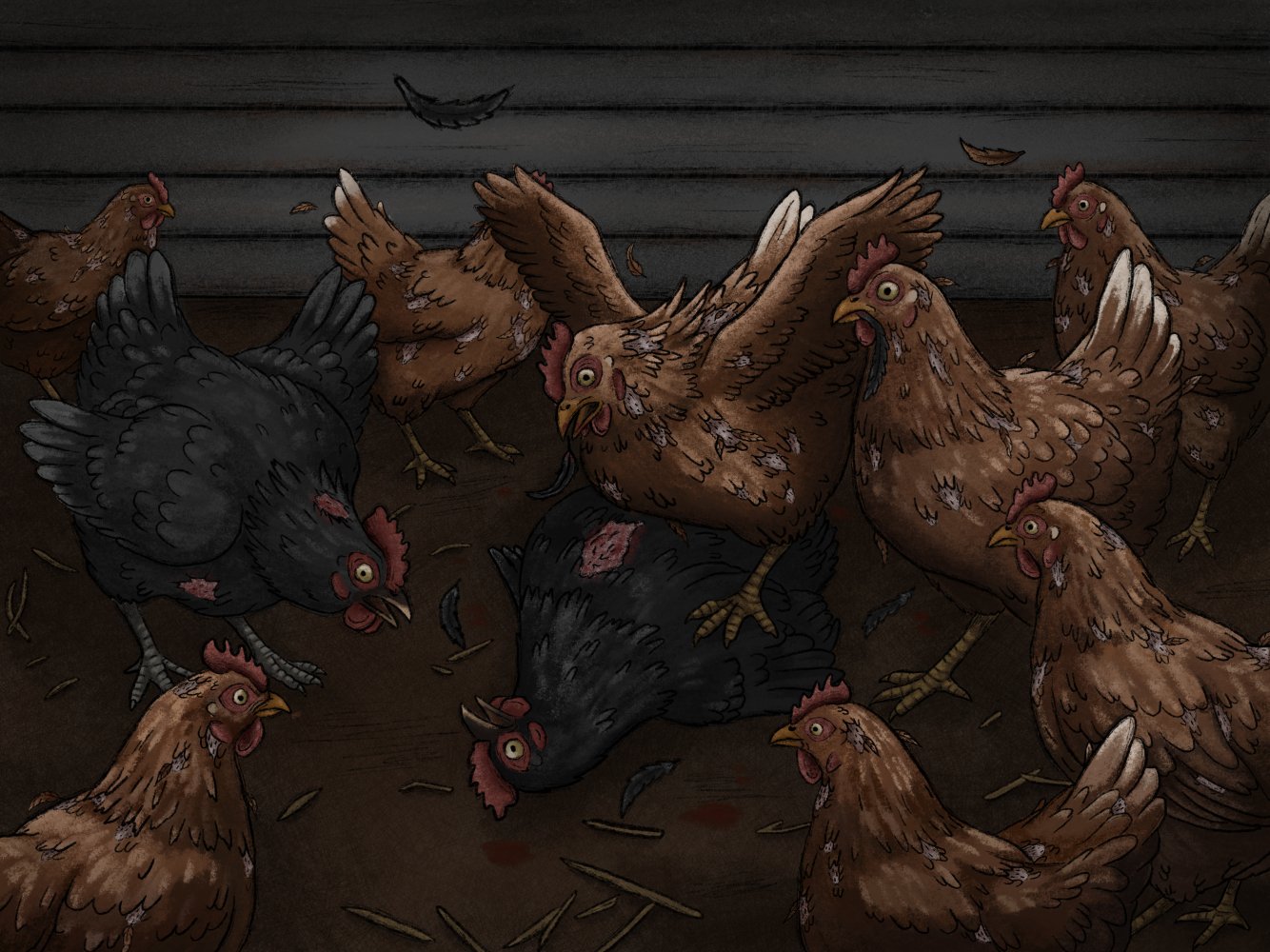
"Josh's brown chickens systematically rounded up any of my hens that were black – Australorps and Marans were particular targets – and pecked them to death. As in, a group of Josh's hens (6+) surrounded one of my heritage birds and pecked heads and bottoms, running around with their intestines and eating my hens' internal organs. It took them only minutes for them to kill another hen. I witnessed this on several occasions. It was absolutely horrific and like nothing I have ever witnessed chickens do.
Josh's hens also picked feathers of some off my heritage birds and ate the feathers or picked at the blood spots created by feather picking. In each instance, it was like they were seeking (fiending for) protein. To watch them it was like a hardcore drug addict, crazed with withdrawal seeking their drug of choice. My organic feed was at a minimum 18% protein, which is an appropriate level for a healthy laying hen."
"Josh's brown chickens systematically rounded up any of my hens that were black... and pecked them to death." (Artist: Jess_hartartist)
Sarah eventually had to separate the birds, and attempted to care for her remaining hens, while Josh's birds continue to cause chaos. After about three weeks, things calmed down, and the surviving hens began to settle in. At the same time, Sarah noticed a sharp decline in egg production from Josh's hens.
"It was as if whatever drug or stimulant that was in the feed they were given as Josh's had worn off and was out of their system. The first night/morning they were with us, they laid more than 200 eggs – more than one per bird. As time progressed and whatever stimulant was in the food wore off, we were lucky to get the equivalent of one egg every two days per hen. I have no direct proof that the birds were drugged, other than my observation of behaviour that was very un-chicken like."
Speaking about this experience to Farm Transparency Project investigators, it was clear that it left its mark on Sarah, not only contributing to the decline of her business but leaving lasting psychological impacts.
"I lost so many of my beautiful Heritage girls as a result of this. In the end, we closed our business and rehomed the girls. Purchasing hens from Josh was a big part of this."
Even five years on, the experience has permanently affected Sarah's impressions of Josh's Rainbow Eggs. Speaking to FTP, she shared that she feared what the farm would do if her statement was traced back to her.
"I've seen how they treat living things. I would not put it past them to seek retaliation against me for sharing my story."
Josh's Lies
Through the course of our investigations into Josh's Rainbow Eggs, we've uncovered a web of deception, a carefully curated image of an 'ethical' egg farm, where compassion comes first. While they've made minor changes to their website, JRE continues to sell this myth, fooling consumers into thinking that, by buying their eggs, they are not supporting animal cruelty.
The truth is, the commercial farming of animals in antithetical to ethics. When you monetise living, sentient beings, suffering is inevitable. It is only through lying that JRE can craft a story that consumers who care about animals want to be part of... because the truth is something that no one wants to buy.