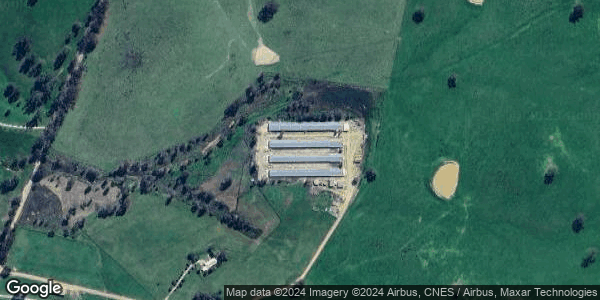
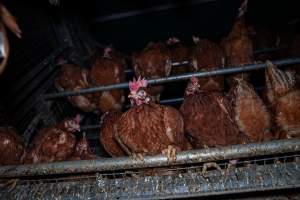
Hen perching in shed - With farms across Central and Northern Victoria, Valley Park Farms proudly markets themselves as being truly free range, no exceptions. On visiting their properties in the North Central Victorian town of Seymour however, we were met with a sight far from the image of 'happy hens' painted on their packaging.

At Valley Park Farms, tens of thousands of hens live in crowded, filthy sheds with only metal bars to perch on. Naturally, hens seek high places to roost but, in these cramped conditions, they are forced to fight for space on one of the faeces encrusted poles, which are arranged in tiers from the floor to the ceiling. 

Hens were found with open wounds, likely from fighting and feather pecking, a symptom of overcrowded sheds. Many hens were missing feathers from their necks, tails and wings, also indicative of cramped sheds with no stimulation. To prevent feather pecking, newborn chicks have their beaks cut, either with a hot blade or a laser. However pecking and cannibalisation are still common, especially in cage free and free range systems.

The sickest and weakest hens sheltered underneath the stacks of perches and nesting boxes. Here, many also lay eggs and could be seen attempting to build nests and sit on eggs. 

Egg laying hens are killed at 12-18 months of age, when their egg production begins to slow. Many don't make it that long. At Valley Park investigators found dead hens decomposing in the sheds, as well as bins of the dead, carelessly discarded alongside rubbish. A pile outside one of the sheds was full of bones and feathers. - Captured at Valley Park Seymour Farm 1 (Fyfe Family Eggs), Seymour VIC Australia.

Hen perching in shed

With farms across Central and Northern Victoria, Valley Park Farms proudly markets themselves as being truly free range, no exceptions. On visiting their properties in the North Central Victorian town of Seymour however, we were met with a sight far from the image of 'happy hens' painted on their packaging.

At Valley Park Farms, tens of thousands of hens live in crowded, filthy sheds with only metal bars to perch on. Naturally, hens seek high places to roost but, in these cramped conditions, they are forced to fight for space on one of the faeces encrusted poles, which are arranged in tiers from the floor to the ceiling.

Hens were found with open wounds, likely from fighting and feather pecking, a symptom of overcrowded sheds. Many hens were missing feathers from their necks, tails and wings, also indicative of cramped sheds with no stimulation. To prevent feather pecking, newborn chicks have their beaks cut, either with a hot blade or a laser. However pecking and cannibalisation are still common, especially in cage free and free range systems.

The sickest and weakest hens sheltered underneath the stacks of perches and nesting boxes. Here, many also lay eggs and could be seen attempting to build nests and sit on eggs.

Egg laying hens are killed at 12-18 months of age, when their egg production begins to slow. Many don't make it that long. At Valley Park investigators found dead hens decomposing in the sheds, as well as bins of the dead, carelessly discarded alongside rubbish. A pile outside one of the sheds was full of bones and feathers.
Categories
Species
Tags
Published Mon 1 December 2025
Captured/filmed June 2025
ID habmhicp2uzinbfgfcto
Credits & licensing
Farm Transparency Project
This work is licensed under a Creative Commons Attribution 4.0 International License.

Creative Commons Attribution 4.0 International
Please credit: Farm Transparency Project. Link not required.
Country Australia
Location

Related campaigns (2)