
The paradox: India's billion-dollar leather industry, despite a cattle slaughter ban
Indian leather exports
India is the second largest producer and consumer of leather footwear in the world.
India is also the second largest exporter of leather garments, the third largest exporter of saddlery & harness, and the fourth largest exporter of leather goods in the world.
Many international brands (both 'budget' brands and 'luxury' labels) source their leather from India at low cost. According to the Council for Leather Exports (CLE), brands that source footwear, leather garments, leather accessories, and other leather goods from India include:
Nike, H&M, Calvin Klein, Reebok, Versace, Zara, Prada, Walmart, Levi's, American Eagle Outfitters, Guess, Hush Puppies, GAP, Armani, Timberland, Tommy Hilfiger, Coach, Mango, Zegna, Banana Republic, Lacoste, and many more.
According to the Council for Leather Exports (CLE):
In the 2024-25 fiscal year, India exported USD 4,828.97 million worth of leather, leather products, and footwear. This consisted of:
Leather Footwear: USD 2,007.76 million
Non-leather Footwear: USD 252.91 million
Footwear Components: USD 244.17 million
Leather Garments: USD 353.82 million
Saddlery and Harness: USD 205.39 million
Finished Leather: USD 445.32 million
Miscellaneous leather goods and accessories: USD 1,319.6 million
These products were exported to over 50 countries and regions. The top 15 destinations for these exports were:
1. U.S.A.: USD 1,045.27 million
2. Germany: USD 542.86 million
3. U.K.: USD 437.94 million
4. Italy: USD 301.13 million
5. Netherlands: USD 247.31 million
6. Spain: USD 245.53 million
7. France: USD 233.18 million
8. U.A.E.: USD 125.51 million
9. China: USD 116.18 million
10. Belgium: USD 109.49 million
11. Poland: USD 94.32 million
12. Vietnam: USD 91.61 million
13. Australia: USD 73.86 million
14. Japan: USD 70.46 million
15. Denmark: USD 55.56 million
The top 15 destinations together account for about 78.48% of India's total exports, with a combined value of USD 3,790.21 million.
The Council for Leather Exports also noted that "The [Indian leather] industry is bestowed with an affluence of raw materials as India is endowed with 20% of [the world's] cattle & buffalo and 11% of [the world's] goat & sheep population[s]."
The United States Department of Agriculture (USDA) estimated that there were about 307 million cattle and Asian domestic water buffalo living in India as of 2024.
The paradox
Since cattle are considered sacred in Hinduism (the dominant religion in India), their slaughter is partially or fully banned throughout most of India. ¹ ²
In India, it is legal to breed and farm cattle for dairy production and agricultural labour such as ploughing and hauling.
For people who want to breed and farm cattle for leather and/or meat, this provides the perfect cover. The cattle will blend right in, as it's legal and common to breed and farm them. The law is only broken when the time comes to slaughter them, or in many states, even to transport them across state lines for slaughter.
Many cattle spend their lives either producing milk or labouring on farms, and when they are no longer economically useful to their owners, they are killed. This produces a continuous stream of cattle funnelling straight into the leather industry.
The obvious question is: how are they being slaughtered if it's illegal?
Method One:
Don't "slaughter" them, but rather abandon them, or deprive them of food or water until they die of dehydration or starvation, or leave them out in the hot sun until they die.
The victims of this method are not always adult cattle at the end of their working lives. Many of them are male calves, "waste" products of the dairy industry.
Because only female cows produce milk, they are far more likely to be kept and fed. Male calves, by contrast, are not seen as "useful" to the dairy industry. Instead, they might be raised to pull ploughs or haul loads on farms, slaughtered for their flesh and/or skin, or simply neglected or abandoned. ¹ ² ³ ⁴
Stray cattle:
Although many of the abandoned cattle die of starvation, thirst, or heatstroke... some who are abandoned in the "right" areas manage to find enough food and water to survive, in fields or in garbage dumps on the streets. There are over five million stray cattle roaming the fields and streets of India, who have been abandoned by their previous owners. On the streets, they have been known to become victims of car accidents. National Geographic reports that "in some states, authorities even paste glow-in-the-dark stickers on the animals to warn drivers at night." National Geographic also notes that "many stray cattle are in poor health, with a gaunt appearance and infected wounds from being hit by vehicles."
Stray cattle, starving and desperate, frequently turn to garbage, eating whatever organic waste they can find, mixed in with plastic and other material that accumulates in their stomachs, unable to be digested.
In 2021, NDTV reported that a pregnant stray cow in Haryana, India was found with 71 kilograms of plastic, nails, marbles, and other garbage in her stomach. Both the cow and her unborn calf died.
Romula D'Silva, vice-president of the Karuna Society for Animals and Nature (an Indian animal protection organisation), said that there are cows eating garbage in "every city in India, big or small... Wherever there are cows on the streets, you can be sure they are full of plastic... They can have very painful deaths".
What happens to the bodies of stray cattle when they die?
CBS News reported, "When cows die they are taken to open fields and left to the scavengers. Sometimes the hides are taken for leather". CBS explained, "Huge dumps have sprouted near urban centers where thousands of dead cows, along with the occasional horse or camel, are brought to rot or be fed upon by feral dogs, crows, and migrant raptors."
In 2026, the Government of India's Minister of State for Environment, Forest and Climate Change, Shri Kirtivardhan Singh, acknowledged "there are instances of dumping of animal carcasses in open public places, water bodies and vacant lands".
Stray cattle who have died are sometimes called "fallen cattle". Although some of the demand for leather is met by the skins of "fallen cattle", the majority of leather in India is made from the skins of animals who were slaughtered.
Method Two:
Slaughter them illegally.
A peer-reviewed study published in the journal 'Animals', notes: "It is estimated that compared to 3,600 legal slaughter houses (for buffaloes, small ruminants and other commercial animals excluding cattle), there are 32,000 unlicensed ones that are quite possibly illegally slaughtering cattle for export or leather."
Animal Equality investigators have repeatedly exposed the illegal slaughter of numerous species of animals in India, including cattle.
Method Three:
Some workers deliberately poison or maim cattle (for example, breaking their legs), so that they can have them 'lawfully' killed. ³ ⁴
Such acts are illegal, but prosecuting them is nearly impossible in practice. Authorities would need to prove an injury was deliberate, rather than one of the numerous "genuine" injuries that animals often suffer during typical overcrowded transport (including broken legs).
Varnika Singh, LLM, a distinguished lawyer and advocate specialising in animal law, reports:
"India's primary legislation for animal protection, the Prevention of Cruelty to Animals Act, 1960, is outdated and toothless. A person who tortures or kills an animal can often walk away with a fine of just Rs 50 [less than one Australian dollar] on a first offence...
Section 325-allowing up to five years' imprisonment for killing or maiming animals-this provision remains underused and poorly enforced.
With such leniency, it's no wonder that cruelty continues unchecked. The lack of deterrence, combined with inadequate enforcement, makes animals the most expendable victims in our society."
Vice Chairman of the Animal Welfare Board of India, Dr. S. Chinny Krishna, writes, "India has probably the best rules in the world for animal protection. However, implementation is virtually zero."
Method Four:
Cattle traffickers in India move cattle hundreds or even thousands of kilometres to one of the few states where they can be "legally" slaughtered, or traffick them across the border into Bangladesh.
ABC Australia reports: "Despite religion and legislation, millions of cows continue to be smuggled across the Indian border each year to neighbouring Muslim-majority Bangladesh."
According to the Government of India, in 2020, the Border Security Force (BSF) seized 46,809 cattle along the Indo-Bangladesh border.
Despite many Indian states making it illegal to transport cattle across state or country borders for slaughter, the practice remains widespread. Traffickers routinely dodge these laws by using strategies such as:
-Falsely declaring the cattle will be used for ploughing, hauling, or dairy production, when in reality they will be slaughtered.
-Crossing after dark over stretches of the border that are not fenced, such as through rivers.
The Hindustan Times reported on one river crossing strategy in more detail: "Tens of thousands of cattle are estimated to be smuggled to Bangladesh annually through the porous 2,216-km India-Bangladesh border in West Bengal."
Continued: "Smugglers were tying the animals to a rudimentary raft and using a flooded river that runs between the two countries to send them across the border."
Image:
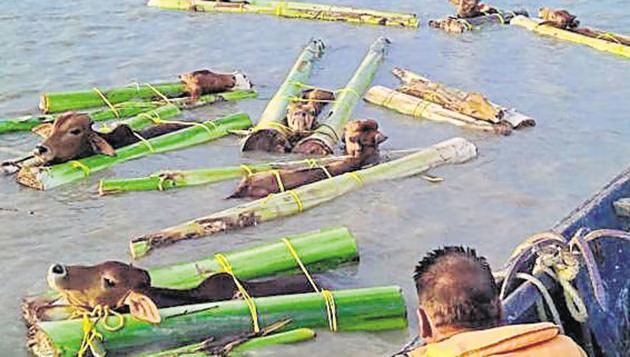
Photograph: Hindustan Times
Download here:
They report, "the heads of the bovines are placed between two banana tree trunks and bound together before they are pushed in the water from where the currents take them to the other side."
Two Border Security Force (BSF) officers, asking not to be named, told the paper: "Smugglers drop cattle mainly at places where the river is over 700-800 metres wide... it is not easy for anyone to chase and seize cattle using boats... The water currents take some cattle to Bangladesh before they could be captured".
A peer-reviewed study published in the journal 'Animals' notes: "Many cattle are smuggled across India's borders for slaughter or travel long distances to those states permitting slaughter (in particular Kerala). They are often sold clandestinely so as not to attract the attention of both lay observers as well as law enforcers... and as a result their transport, lairage and slaughter are driven underground. The conditions that these animals are kept, transported and handled remains completely unregulated."
...
Continued: "Studies of Bangladeshi abattoirs and livestock markets have found that many of the cattle were legally or illegally exported from India by trek, truck or train. One estimate puts the numbers at 1.7 million cattle get exported annually, the majority of which are slaughtered for meat production. Many of these animals show severe nose and tail injuries, dehydration and metabolic exhaustion, hyperthermia and death during transport."
"There is a huge amount of trafficking of cattle to [the Indian states] West Bengal and Kerala...The ones going to West Bengal go by truck and train and they go by the millions. The law says you cannot transport more than 4 per truck but they are putting in up to 70. When they go by train, each wagon is supposed to hold 80 to 100, but they cram in up to 900. I've seen 900 cows coming out of the wagon of a train, and 400 to 500 of them came out dead."
"The trade exists because of gross corruption. An illegal organisation called the Howrah Cattle Association fakes permits saying the cattle are meant for agricultural purposes, for ploughing fields or for milk. The stationmaster at the point of embarkation gets 8,000 rupees per train-load for certifying that the cows are healthy and are going for milk. The government vets get X amount for certifying them as healthy."
"Between 10,000 and 15,000 cows go across [the India-Bangladesh] border every day."
"On the route to Kerala they don't bother with trucks or trains: they tie them and beat them and take them on foot, 20,000 to 30,000 per day."
"Because they have walked and walked and walked the cattle have lost a lot of weight, so to increase the weight and the amount of money they will receive, the traffickers make them drink water laced with copper sulphate, which destroys their kidneys and makes it impossible for them to pass the water - so when they are weighed they have 15kg of water inside them and are in extreme agony."
"To keep them moving, drivers beat the animal across their hip bones, where there is no fat to cushion the blows. The cows are not allowed to rest or drink. Many cows sink to their knees. Drivers beat them and twist their battered tails to force them to rise. If that doesn't work they torment the cows into moving by rubbing hot chilli peppers and tobacco into their eyes."
Courts have since been forced to address this practice: "The Madras High Court has ordered an end to the practice of smearing the chilli flakes on the eyes of cattle to keep them awake during long journeys and also to prevent them from sitting/lying down inside the truck." However, since illegal animal cruelty in India is widespread, this practice will no doubt continue.
Investigators from People for the Ethical Treatment of Animals (PETA) India report, "by the time they arrive at the slaughterhouse, some animals are dead, and many are so sick and injured that workers must drag them inside".
At the slaughterhouse, Mrs Gandhi reports, "In Kerala... they beat their heads to a pulp with a dozen hammer blows."
PETA India investigators found additional methods of slaughter; "Their throats are cut in full view of other cattle, who are forced to watch and wait. Some have their legs hacked off while they're still conscious, and some endure the agony of being skinned alive."
The flesh and skins of these animals are used for meat and/or leather.
Indian workers involved in trafficking, killing, and skinning animals are often in these jobs because they lack other options, trapped in systemic, generational poverty.